
Educational field trips bring coding and technology concepts to life by connecting classroom learning with hands-on experiences in the real world. At ESDNL, these excursions aren’t just fun breaks from routine. They’re carefully designed opportunities for children to see how the digital skills they’re developing actually work in museums, nature centers, local businesses, and community spaces.
Think of field trips as the bridge between screen time and real time. When kids learn about sensors and data collection in class, visiting a weather station shows them these concepts in action. When they explore animation techniques, a trip to a local design studio reveals the creative careers waiting for them. These experiences answer the question every parent hears: “But when will I actually use this?”
The magic happens when children make those connections themselves. A quiet moment observing how traffic lights use programmed sequences, or watching a 3D printer create something tangible from digital code, often sparks deeper understanding than any lesson plan alone. Field trips also build confidence for children who might feel unsure about technology, showing them that coding isn’t confined to computers or reserved for certain types of learners.
For parents worried about too much screen time, these outings offer reassurance. Technology education extends far beyond keyboards and monitors. It’s about problem-solving, creativity, and understanding the systems that shape our daily lives. Field trips remind us that the best learning often happens when we step outside, look around, and discover together.
What Makes Educational Field Trips Essential in 2026
In 2026, screens dominate nearly every aspect of learning, from virtual classrooms to coding tutorials that kids complete entirely online. Yet paradoxically, this digital saturation makes hands-on educational field trips more valuable than ever. When children step away from their devices and into real environments, something shifts. They stop being passive consumers of information and become active participants in discovery.
The magic lies in what researchers call learning by doing a principle that’s been proven to create deeper understanding than any lecture or video can achieve. When your child watches a programmer explain code on a screen, it’s informative. When they stand in an actual tech workspace, see the collaborative energy, and ask questions face-to-face, that experience embeds itself in their memory. They remember the smell of the office, the excitement in the developer’s voice, the unexpected detail that made them think differently.
Field trips also address what online education simply can’t replicate: the social and emotional dimensions of learning. Kids learn to navigate unfamiliar spaces, interact with professionals, and connect abstract concepts they’ve studied to tangible applications. A child who’s struggled with a coding concept for weeks might suddenly grasp it when they see that exact principle solving a real problem at a local tech company.
These experiences don’t replace digital learning, they complete it. Think of field trips as the bridge between “I know how to write this code” and “I understand why this matters.” That shift from knowledge to meaning is what transforms a lesson into lasting inspiration.
The ESDNL Approach: Where Coding Meets Real-World Discovery
Tech Industry Visits That Inspire Future Innovators
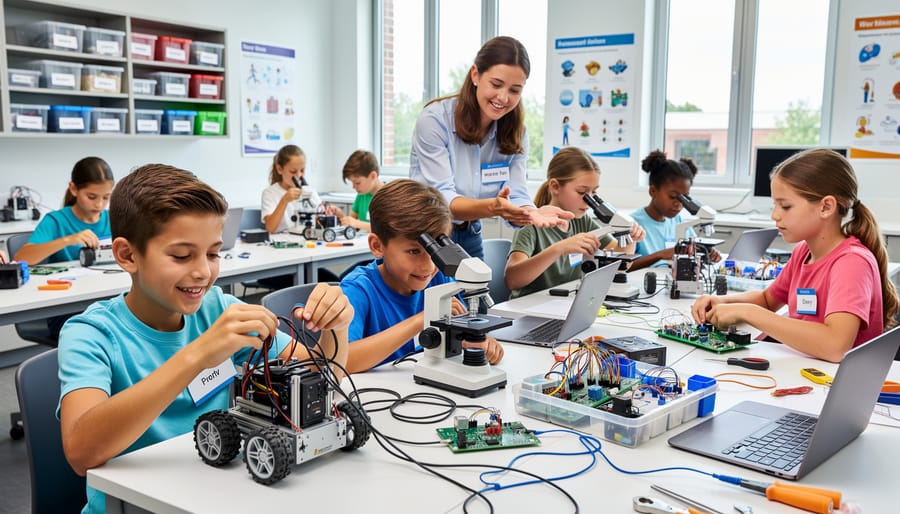
When children walk through the doors of a working tech company, they’re not just observing, they’re reimagining what’s possible for their own futures. ESDNL’s tech industry visits take students behind the scenes at local startups, established software firms, and innovation hubs where real code becomes real products.
During these visits, children watch developers collaborate on projects, see user interface designers sketch app layouts on whiteboards, and learn how quality assurance testers hunt for bugs. They ask questions directly to professionals who once sat in classrooms just like them. One student left a game development studio visit determined to create her own adventure game, having seen that the people making her favorite apps were just regular people who learned to code.
These experiences transform abstract concepts into concrete career paths. Children discover that programmers work in teams, that mistakes are part of the process, and that coding jobs exist in industries they never imagined, from healthcare apps to environmental monitoring systems.
The visits also showcase diverse tech roles beyond programming: project managers coordinating releases, technical writers explaining features, and systems administrators keeping everything running smoothly. Students realize that their unique interests and strengths all have a place in the technology world.
Community Connections Through Technology
Field trips that connect coding skills to community service show children how technology can solve real problems and help real people. When students visit local nonprofits using custom databases to track food bank donations or apps to coordinate volunteer schedules, they see their programming skills translated into tangible impact.
Community tech centers offer another powerful learning environment. Here, children observe how organizations teach digital literacy to seniors, help job seekers build online portfolios, or provide internet access to underserved neighborhoods. These visits reveal technology’s role as an equalizer, not just entertainment.
ESDNL prioritizes partnerships with organizations where students can witness coding making a difference. A visit to a community health center might show how appointment reminder systems reduce missed checkups. A stop at an environmental group could demonstrate how data visualization helps track local air quality or wildlife populations.
These experiences plant important seeds. Children begin asking, “How could I build something that helps people?” rather than just “What can I code?” They start viewing themselves as future problem-solvers with skills that matter beyond the computer lab. The shift from learning syntax to understanding purpose happens naturally when children see their community thriving through technology.
What Your Child Actually Learns on a Coding Field Trip
When your child steps onto a bus for a coding field trip, they’re picking up far more than programming syntax. These experiences create learning opportunities that simply can’t happen within four classroom walls or through a screen alone.
The technical skills matter, certainly. Children see how the code they write translates into actual products, services, and solutions people use daily. At a tech company, they might watch developers troubleshoot a real bug or see how user feedback shapes software updates. That connection between abstract code and tangible outcomes makes concepts like debugging, testing, and iteration suddenly click in ways that theoretical lessons rarely achieve.
But here’s what makes field trips genuinely transformative:
- Communication skills through asking professionals questions and articulating their own ideas about technology
- Teamwork and collaboration when navigating new environments alongside classmates
- Adaptability and confidence when encountering unfamiliar situations and technology they haven’t seen before
- Career awareness by observing diverse roles within tech organizations beyond just “programmer”
- Cultural literacy around workplace norms, professional behavior, and industry expectations
- Critical thinking when comparing what they learned in class with how professionals actually work
Your child returns with stories, not just information. They remember the developer who showed them how she uses code to help hospitals track medicine, or the moment they realized their geography teacher’s sister works as a data analyst. These narratives stick because they’re connected to real people and places, creating mental hooks that pure instruction can’t replicate.
Field trips also reveal the human side of technology careers. Children meet professionals from various backgrounds, see different personality types thriving in tech, and realize that coders aren’t all introverts hunched over keyboards in dark rooms. That expanded view matters tremendously for children who might not otherwise picture themselves in technology fields, especially girls and students from underrepresented communities who need to see possibilities that mirror their own identities.
Making Field Trips Accessible: ESDNL’s Community-First Philosophy
ESDNL believes every child deserves access to enriching educational field trips, not just those whose families can afford extra fees or transportation. That’s why they’ve built their entire field trip program around removing barriers rather than creating them.
Transportation poses one of the biggest obstacles for families. ESDNL coordinates group travel and works with local partners to arrange bus services, carpools, and volunteer drivers when needed. No child misses out because their family lacks a vehicle or can’t take time off work to drive.
Financial accessibility matters equally. ESDNL keeps field trip costs minimal or waived entirely through community sponsorships and partnerships with local businesses. They’ve secured relationships with tech companies and organizations that open their doors to student groups at no charge, understanding the investment in future talent and community goodwill.
The organization also recognizes that accessibility extends beyond money and logistics. Some children need different support structures to fully participate. ESDNL maintains small group sizes and brings along extra volunteers to ensure students with varying learning needs, physical abilities, or anxiety levels can engage comfortably. They communicate with parents beforehand to understand each child’s requirements and adapt accordingly.
Language shouldn’t limit participation either. ESDNL provides materials and explanations in multiple languages when serving diverse communities, ensuring parents understand trip details and children can process what they’re learning.
This community-first approach reflects ESDNL’s core mission: technology education should unite communities, not divide them. When field trips become accessible to everyone, children learn alongside peers from different backgrounds, creating richer conversations and broader perspectives. The diversity itself becomes part of the educational value, teaching empathy and collaboration alongside coding concepts.
How Parents and Educators Can Maximize the Field Trip Experience
The real magic of educational field trips happens when parents and educators actively bridge the experience with ongoing learning. A field trip isn’t just a single day out, it’s an opportunity to deepen curiosity and reinforce skills over time.
Start by setting clear intentions. Before the trip, talk with your child about what they’ll see and do. Ask what excites them most about visiting a tech company or community center. This simple conversation primes their brain to notice details and ask questions during the experience. Share any background information ESDNL provides about the location, but keep it conversational rather than lecture-style.
- Review the trip destination and activities together two or three days beforehand, encouraging your child to write down one question they want answered.
- During the trip, take photos of specific moments that capture your child’s attention, these become valuable prompts for later discussions.
- Within 24 hours after returning, spend ten minutes talking about the most surprising thing they learned or saw.
- Over the following week, connect the experience to a current project or lesson by asking how they might apply what they observed.
- Create a simple reflection activity like drawing their favorite moment, writing three new ideas they got from the trip, or teaching a sibling about something they discovered.
The follow-through matters as much as the preparation. Reference the trip in everyday conversations when relevant topics come up. If your child visited a startup and now sees a news story about app development, make that connection explicit. These moments reinforce that learning doesn’t stop when the bus returns to school.
Teachers can amplify this by dedicating class time for students to share their takeaways with peers who might have noticed different details. Group discussions often reveal insights individual children missed, extending the educational value for everyone. The goal is weaving the field trip into the larger learning narrative rather than treating it as an isolated event.
Beyond the Classroom: Field Trips as Creativity Catalysts
Field trips do something remarkable to a child’s imagination, they shake loose creative ideas that would never emerge staring at a screen in the same room every week. When children experience a new environment, especially one where technology intersects with unexpected contexts, their brains start making connections that become the foundation for innovative projects.
Take what happened after ESDNL students visited a local greenhouse using automated growing systems. Instead of simply admiring the technology, several children returned home buzzing with ideas: designing games about plant growth cycles, creating apps to remind families when to water houseplants, and even proposing environmental sensors that could “talk” to their coding projects. The trip planted seeds, literally and figuratively, that blossomed into original work reflecting their own curiosities.
This pattern repeats across different field trip destinations. A visit to an animation studio might inspire a child who previously struggled with abstract coding concepts to suddenly grasp variables and loops because they’ve seen how animators bring characters to life frame by frame. Walking through a museum with interactive exhibits can trigger questions about user experience that transform how students approach their own program designs.
The key lies in exposure to contexts where technology serves a purpose beyond itself. Children stop seeing coding as an isolated skill and start recognizing it as a creative tool for solving problems, telling stories, or building things that matter to them. Those sparks of inspiration, captured in a moment of wonder during a field trip, often fuel months of engaged learning afterward, as students chase down ideas that genuinely excite them.
Educational field trips transform how children understand and connect with technology. When your child visits a tech startup, explores a community innovation hub, or sees coding solve real problems in the world, something clicks that no screen-based lesson can replicate. These experiences show them that technology is not about staring at computers, it’s about creating solutions, building communities, and making things happen.
ESDNL’s commitment to hands-on learning through field trips reflects what modern tech education should be: engaging, accessible, and deeply connected to the real world. These outings give children context for their coding skills, show them potential career paths, and most importantly, help them see themselves as future innovators who can use technology to make a difference.
As parents and educators, seeking out experiential learning opportunities matters. Look for programs that take children beyond the classroom. Ask how coding education connects to the wider world. Support organizations that prioritize community and real-world applications.
Your child’s tech education journey should include moments of wonder, discovery, and connection. Field trips provide exactly that, a chance to see technology as a tool for engaging with life, not escaping from it.