
Imagine your child teaching a virtual puppy to find hidden treats by trying different paths, learning from mistakes, and celebrating successes. That’s essentially Q-learning – a powerful artificial intelligence concept that even young learners can grasp through play and experimentation.
Q-learning empowers computers to make smart decisions by learning from experience, much like children learn to ride a bike through trial and error. Instead of programming every possible answer, we create environments where machines discover the best solutions themselves. This approach mirrors how your child naturally learns: try something, see what happens, adjust, and try again.
Picture a simple game grid where a character searches for treasure. Each move earns points or penalties, teaching the character which paths work best. Over hundreds of attempts, patterns emerge, and the character becomes remarkably skilled at finding treasure quickly. This feedback loop – action, consequence, learning, improvement – forms the heart of Q-learning and creates an engaging way for children to understand how machines think.
Parents and educators don’t need computer science degrees to introduce these concepts. Through hands-on activities, colorful visual examples, and game-based projects, young learners can explore reinforcement learning principles while developing critical thinking skills and computational confidence. The beauty lies in making abstract AI concepts tangible through stories, experiments, and creative problem-solving that feels less like studying and more like an exciting discovery adventure.
What Is Q-Learning? (Explained for Kids and Parents)
Imagine teaching a puppy to find its favorite toy hidden somewhere in your house. At first, the puppy wanders randomly, sniffing here and there. But every time it gets closer to the toy, you give it a treat and some enthusiastic praise. Soon enough, your puppy learns the quickest path to that toy without any help. That’s essentially how Q-learning works!
Q-learning is a reinforcement learning technique where computers or robots learn to make smart decisions by trying different actions and discovering which ones earn the best rewards. Just like your puppy learning through treats, Q-learning teaches machines through a system of points or rewards.
Let’s use another example your kids might love: imagine a video game character trying to escape a maze. The character doesn’t know the way out at first, so it tries different paths. When it moves toward the exit, it gets points. When it hits a dead end, it gets nothing or loses points. After playing many times, the character builds a mental map of which moves work best in each situation. That collection of learned experiences is called a Q-table, like a report card showing which actions score highest.
The beauty of Q-learning is that it mirrors how children naturally learn through exploration and feedback. When your child learns to ride a bike, they adjust their balance based on whether they stay upright or wobble. They’re naturally doing a form of Q-learning! This makes the concept relatable and exciting for young learners who can see themselves as the intelligent agents solving problems.
The best part? Your children can start experimenting with these concepts through coding games and creative projects, building problem-solving skills that extend far beyond computers.
Why Q-Learning Matters for Young Coders
You might wonder why teaching Q-learning to young coders matters when they’re still mastering basic programming concepts. The truth is, introducing these foundational machine learning ideas early prepares children for a world where artificial intelligence touches everything from healthcare to entertainment, transportation to education.
When kids learn Q-learning, they’re not just memorizing algorithms. They’re developing critical problem-solving skills that translate across subjects and situations. Research shows that coding enhances cognitive development, particularly in areas like logical thinking, pattern recognition, and systematic decision-making. Q-learning takes this further by teaching children to think about consequences, rewards, and how to optimize choices over time.
Consider twelve-year-old Maya, who used Q-learning principles to create a game where characters learned from their mistakes. She didn’t realize she was applying machine learning concepts at first. She just wanted her game characters to get smarter. That curiosity led her to explore AI further, and she’s now mentoring younger students in her school’s coding club.
The beauty of Q-learning is how it mirrors real life. Kids naturally understand trial and error because they live it every day, whether learning to ride a bike or figuring out a challenging puzzle. Q-learning formalizes this intuitive process, giving them a framework to approach complex problems with confidence.
By introducing these concepts now, you’re not just preparing your child for future careers in technology. You’re equipping them with adaptable thinking skills that will serve them regardless of their chosen path. The creative problem-solving mindset developed through Q-learning becomes a lifelong asset, empowering young learners to tackle challenges with innovation and resilience.
Making Q-Learning Fun and Interactive for Children
Game-Based Learning Approaches
One of the most exciting ways to introduce Q-learning to young learners is through game-based activities that feel more like play than learning. Grid-world games are perfect starting points where children create simple virtual worlds made up of squares, like a checkerboard. Their programmed character starts in one square and needs to reach a goal, learning through experience which moves lead to success.
Treasure hunt simulations bring this concept to life with colorful visuals and engaging storylines. Kids design environments where their character searches for hidden treasures, encountering obstacles and rewards along the way. With each attempt, the character gets smarter, remembering which paths led to treasure and which led to dead ends. It’s magical watching children realize their creation is actually learning from mistakes, just like they do.
Maze-solving activities offer another captivating approach. Young coders build mazes and program characters to find the exit through trial and error. Initially, the character might bump into walls or take wrong turns, but gradually it discovers the optimal path. This visual representation of learning makes abstract concepts tangible and relatable.
These game-based approaches create a supportive learning community where children share their creations, compare strategies, and celebrate each other’s successes. They’re not just learning about artificial intelligence; they’re becoming creative problem-solvers who understand that mistakes are valuable learning opportunities. The best part? Kids often don’t realize they’re mastering complex concepts because they’re having too much fun designing their own learning adventures.
Visual Programming Tools
Making Q-learning visible and tangible transforms it from an abstract concept into something children can actually see and manipulate. Visual programming tools bridge this gap beautifully, turning complex algorithms into colorful, interactive experiences that young learners can grasp intuitively.
Think of visual programming platforms as the training wheels of artificial intelligence education. Just as your child learned to ride a bike by first seeing how the wheels turned and the pedals worked, these tools let them watch Q-learning happen in real-time. Block-based coding environments, similar to digital building blocks, allow kids to snap together commands and immediately observe how their AI agent learns and improves.
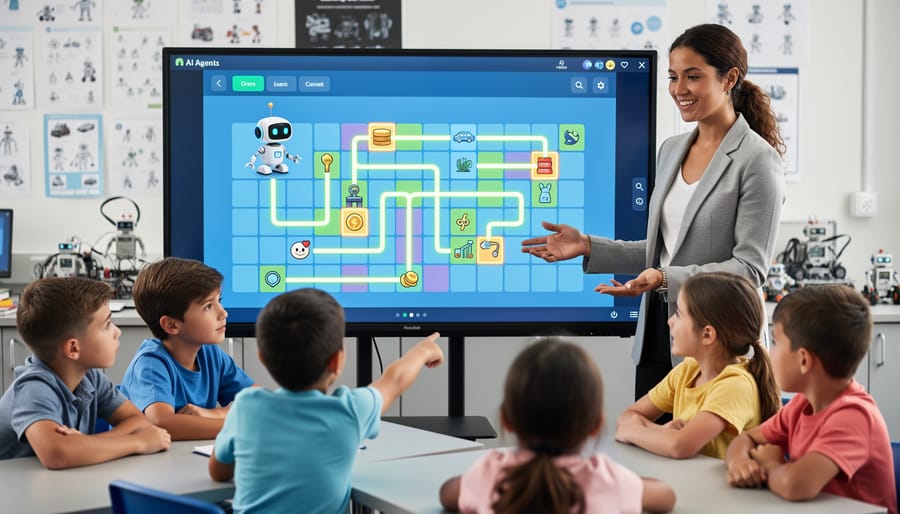
Several platforms have adapted Scratch-like interfaces specifically for reinforcement learning. These environments display learning tables, reward systems, and decision-making processes through animations and visual feedback. Your child might create a simple maze game where they can literally see the agent’s “brain” update as it discovers which paths lead to rewards and which lead to dead ends.
The beauty of these tools lies in their immediate feedback. When children adjust a parameter or change a reward value, they witness the consequences unfold on screen. This cause-and-effect visibility makes debugging feel like detective work rather than frustration. Plus, many platforms include built-in tutorials with friendly characters that guide learners step-by-step, celebrating small victories along the way.
These visual environments also foster creativity, letting kids design their own learning scenarios while building a strong foundation in AI concepts that will serve them well as they grow.
Step-by-Step: A Simple Q-Learning Project for Beginners
What You’ll Need
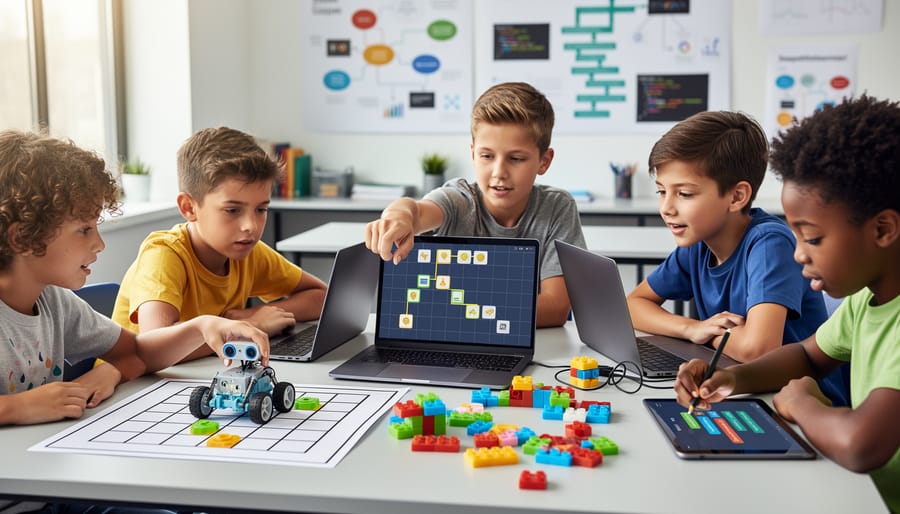
Getting started with Q-learning adventures requires just a few simple, budget-friendly items! You’ll need a computer, tablet, or laptop with internet access—nothing fancy required. We recommend using free, kid-friendly platforms like Scratch, which makes learning interactive and visual, or Google Colab for older learners ready to explore Python basics. A notebook and colorful markers are wonderful for sketching out ideas, drawing reward charts, and mapping out simple mazes before building them digitally. For hands-on fun, gather household items like cardboard, toy figures, or even Lego blocks to create physical game boards that bring Q-learning concepts to life. The beauty of this learning journey is its accessibility—you don’t need expensive software or special equipment. Everything can be done with tools you likely already have at home, and the supportive online coding community offers countless free tutorials and resources to guide you every step of the way!
Breaking Down the Learning Process
Watching a Q-learning program come to life is like seeing your child learn to ride a bike. At first, there’s wobbling and falling, but gradually, confidence builds and success follows. Help your young learner understand this beautiful process by breaking it down together.
Start by running the program in slow motion. Many beginner-friendly coding platforms let you adjust speed, so children can watch each decision their character makes. Point out when the character bumps into a wall or takes a wrong turn—these aren’t failures, they’re learning moments! Ask questions like, “Why do you think it went that way?” or “What do you think it learned from that mistake?”
Create a simple tracking system together. Draw a chart where your child can mark successful attempts versus unsuccessful ones. They’ll visually see the improvement over time, which is incredibly motivating. You might notice patterns emerging—perhaps the character keeps getting stuck in the same corner initially but eventually figures out a better path.
Encourage your child to predict what will happen next. “If the character goes left here, what might it learn?” This engages critical thinking and helps them connect actions with consequences, a fundamental concept in both coding and everyday life.
Remember, the goal isn’t perfection on the first try. Celebrate the messy middle part where real learning happens. When your child sees their virtual character finally master the maze after dozens of attempts, they’re witnessing persistence pay off—a lesson that extends far beyond coding.
Extending the Project
Once your child has mastered the basics of Q-learning, the real fun begins! This is where their creativity can truly shine. Encourage them to think of their Q-learning project as a starting point rather than a finished product.
One exciting extension is adding obstacles to their environment. If they’ve created a simple grid where their character learns to reach a goal, try placing barriers or traps that result in negative rewards. This teaches the agent to navigate around problems, just like we do in real life. Your child can experiment with different obstacle patterns and watch how their character adapts its strategy.
Changing the reward system opens up endless possibilities. What if there are multiple goals with different point values? Maybe collecting a special item gives bonus points, or taking too long results in a small penalty. These variations help kids understand how changing rules affect learning behavior.
Creating multiple characters adds another dimension of excitement. Perhaps two agents can race to the goal, or work together cooperatively. Some families have even created characters with different learning speeds or abilities, leading to wonderful discussions about fairness and different learning styles.
Remember, there’s no wrong way to extend the project. Every modification is a learning opportunity. Celebrate the experiments that don’t work as expected because they often teach the most valuable lessons. The community of young coders is full of creative ideas, so encourage your child to share their innovations and learn from others.
Common Questions Parents and Educators Ask
We know you might have some questions about introducing Q-learning to young minds, and that’s completely natural! Teaching advanced concepts to children can feel daunting, but remember that kids are natural learners who thrive when given the right support and encouragement.
What age is appropriate for learning Q-learning?
Children as young as 10 can grasp basic Q-learning concepts through games and visual activities, while teens aged 13-16 can dive into more detailed implementations. Younger children (ages 6-9) can explore the foundational ideas through simple reward-based games without needing to understand the technical details.
Does my child need advanced math skills first?
Not at all! While Q-learning involves mathematics, children can learn the concepts through hands-on activities and visual tools before understanding the underlying equations. Basic addition and pattern recognition are helpful starting points.
How long does it take for kids to understand Q-learning?
Most children grasp the basic concepts within 4-6 weeks of regular practice, spending about 30-45 minutes per session twice a week. The key is consistency and keeping activities fun rather than rushing through material.
What should I do if my child gets frustrated?
Take breaks, simplify the activity, and celebrate small wins! Frustration is a normal part of learning challenging concepts, so encourage persistence while making sure the experience stays positive and pressure-free.
The beauty of teaching Q-learning to children is that you don’t need to be an expert yourself. Many parents and educators successfully guide young learners by exploring together, creating a wonderful opportunity for shared discovery. When challenges arise, lean on your community for support, whether that’s online forums, local coding clubs, or fellow parents on the same journey.
Remember that every child learns at their own pace. Some might immediately connect with the trial-and-error nature of Q-learning, while others need more time to warm up to the concepts. Both paths are perfectly valid! The goal isn’t to create the next AI researcher but to nurture curiosity, problem-solving skills, and creative thinking that will serve them well in any future they choose.
Building Community Around AI Learning
Learning Q-learning doesn’t have to be a solitary journey. In fact, some of the most exciting breakthroughs happen when young learners come together to share ideas, troubleshoot challenges, and celebrate their achievements. Building a supportive community around AI learning transforms what could be an intimidating topic into an adventure everyone can enjoy together.
Consider starting or joining a coding club focused on AI and reinforcement learning. These clubs create safe spaces where children can experiment with Q-learning projects, from training virtual pets to designing game-playing agents. When kids see their peers tackling similar challenges, they realize they’re not alone in their learning journey. The collaborative atmosphere turns frustration into fun problem-solving sessions where everyone contributes their unique perspective.
Peer collaboration brings tremendous value to understanding Q-learning concepts. Imagine two students working together on a maze-solving project—one excels at visualizing the problem while the other thinks strategically about reward systems. Together, they create something neither could have built alone. This partnership approach mirrors how professional AI researchers actually work, making the learning experience both authentic and empowering.
Showcase events give young coders the chance to demonstrate their Q-learning creations to family and friends. Whether it’s a school science fair or a community tech night, these celebrations validate their hard work and inspire others to explore AI. Parents don’t need technical expertise to participate—your enthusiasm and encouragement mean everything to young learners.
Getting involved is simple: attend project presentations, ask curious questions about their work, and connect with other families on similar learning paths. Many schools and community organizations already offer tech-focused extracurricular programs that welcome parent volunteers. By joining this community, you’re not just supporting your child—you’re helping build a generation of creative, confident problem-solvers ready to shape our technological future.

You’ve taken an exciting step today by exploring Q-learning with your child, and that’s something to celebrate! Remember, introducing kids to reinforcement learning isn’t about becoming an expert overnight. It’s a journey filled with discovery, experimentation, and yes, plenty of wonderful mistakes along the way. Those “oops” moments when the virtual character walks into a wall or chooses the wrong path? They’re actually golden teaching opportunities that show children how learning really works.
The beauty of Q-learning is that it mirrors life itself. We all learn by trying, sometimes failing, and adjusting our approach. By guiding your child through this process, you’re not just teaching them about algorithms—you’re building their resilience, problem-solving skills, and confidence to tackle complex challenges.
You don’t need to have all the answers. Your enthusiasm and willingness to learn alongside your child is what matters most. Connect with other parents and educators in your community who are on this journey, share your experiences, and celebrate the creative solutions your children discover.
Start small, stay curious, and watch as your child develops skills that will serve them in our increasingly tech-driven world. The future belongs to creative thinkers and innovative problem-solvers. By introducing Q-learning today, you’re preparing your child to thrive in tomorrow’s possibilities. Take that first step—your child’s amazing learning adventure awaits!